

Mohamed Alabbar’s $20 Billion Investment: A New Chapter for Syria’s Economy
By Global Arab Network
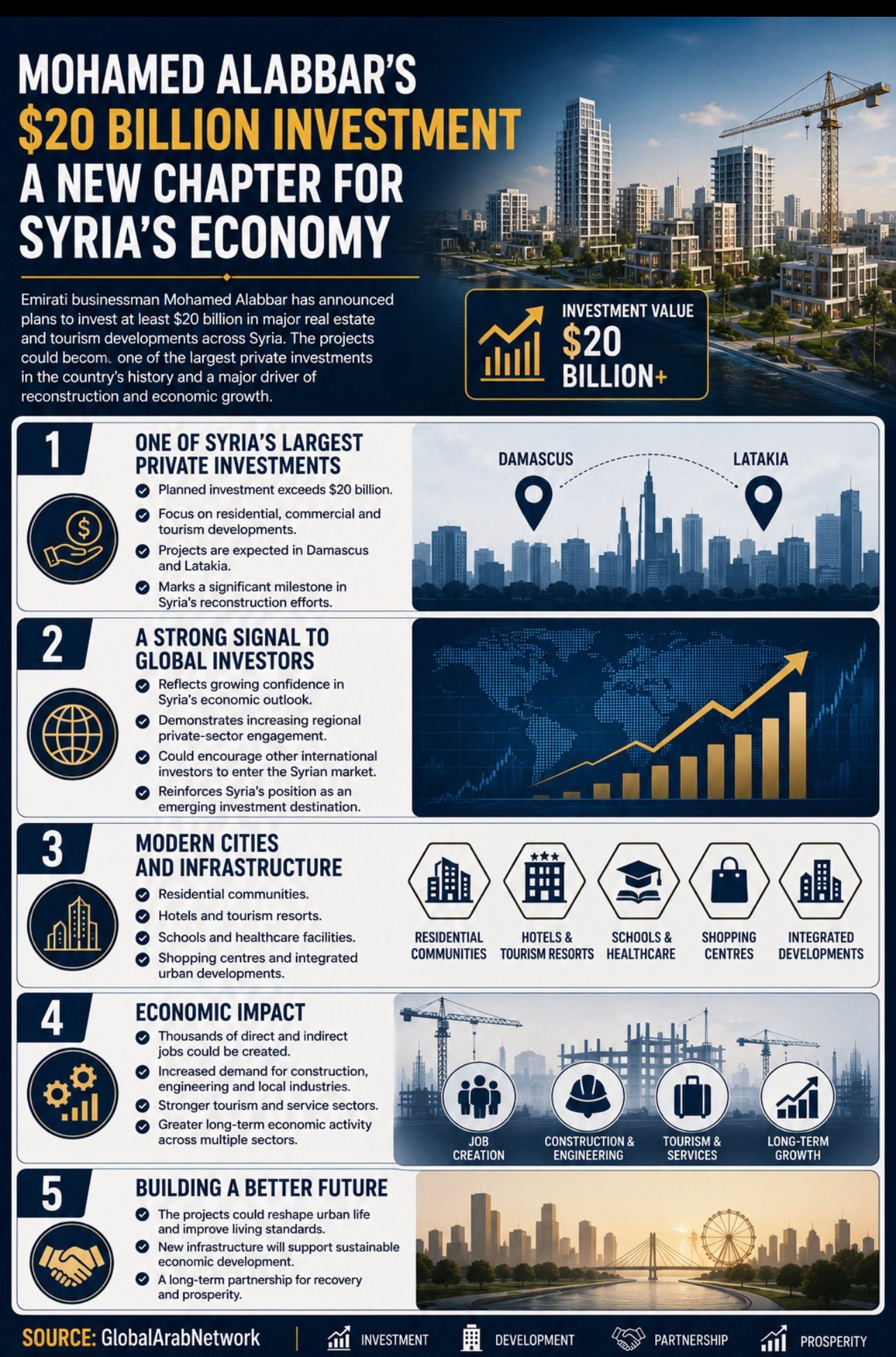
Emirati businessman Mohamed Alabbar has announced plans to invest at least $20 billion in large-scale real estate, tourism, and mixed-use developments across Syria, marking what could become one of the largest private investment initiatives in the country’s modern history. The proposed projects, expected to include major developments in Damascus and Latakia, are widely viewed as a significant milestone in Syria’s economic recovery and reconstruction efforts.
If implemented as planned, the investment would not only transform the urban landscape of key Syrian cities but also send a powerful signal to regional and international investors that Syria is entering a new phase of economic development focused on rebuilding infrastructure, attracting private capital, and creating sustainable long-term growth.
One of Syria’s Largest Private Investments
With a planned value exceeding $20 billion, the proposed investment ranks among the most ambitious private-sector commitments announced since the beginning of Syria’s reconstruction process.
The projects are expected to focus on large-scale residential, commercial, hospitality, and tourism developments designed to meet growing demand for modern housing, business facilities, and leisure destinations.
According to preliminary plans, major developments are expected in Damascus, the country’s political and economic capital, and Latakia, Syria’s principal Mediterranean port city. These locations are considered strategic centres for future investment because of their economic importance, transport links, and tourism potential.
Observers believe the scale of the investment reflects increasing confidence in Syria’s long-term economic prospects and demonstrates the growing willingness of regional investors to participate in rebuilding the country’s economy through large private-sector projects.
A Strong Signal to Global Investors
Beyond its financial value, the announcement carries significant symbolic importance.
Major investments by internationally recognised business leaders often influence broader investor confidence. Alabbar’s decision to pursue large-scale projects in Syria is expected to reinforce perceptions that the country is gradually becoming an attractive destination for long-term capital investment.
The initiative also highlights the expanding role of Gulf private-sector investment in supporting economic development across the region. Increased participation by Emirati investors could encourage companies from other Gulf Cooperation Council (GCC) countries, as well as international investment funds, to explore opportunities in sectors such as construction, tourism, logistics, manufacturing, and infrastructure.
Economists note that large anchor investments frequently generate a multiplier effect by attracting suppliers, contractors, financial institutions, and complementary businesses, creating broader economic momentum beyond the original projects.
As Syria continues implementing economic reforms and expanding partnerships with regional investors, announcements of this scale may help strengthen international confidence in the country’s evolving investment environment.
Building Modern Cities and Integrated Communities
The proposed developments extend well beyond traditional real estate construction.
Plans are expected to include integrated urban communities combining residential, commercial, educational, healthcare, and recreational facilities within carefully planned modern neighbourhoods.
Among the projects under consideration are:
- Large residential communities designed to meet increasing demand for quality housing.
- International-standard hotels and tourism resorts aimed at expanding Syria’s hospitality sector.
- Modern schools and educational facilities serving growing urban populations.
- Healthcare centres equipped to support expanding residential developments.
- Shopping centres, entertainment venues, and commercial districts designed to stimulate retail activity.
- Mixed-use developments integrating housing, offices, leisure facilities, and public spaces.
Such integrated developments have become a defining feature of major urban projects across the Gulf region and are increasingly viewed as models for sustainable city planning, combining economic activity with improved quality of life.
Driving Economic Growth
The potential economic impact of a $20 billion investment could extend across multiple sectors of the Syrian economy.
During the construction phase alone, thousands of engineers, architects, contractors, technicians, and skilled workers would be employed directly on the projects. Additional demand would also support suppliers of cement, steel, glass, electrical equipment, transport services, and other locally produced materials.
The multiplier effect could generate tens of thousands of direct and indirect employment opportunities, particularly in construction, engineering, logistics, manufacturing, retail, hospitality, and professional services.
As completed developments become operational, the projects would support long-term employment in hotels, retail businesses, property management, education, healthcare, tourism, maintenance, and public services.
The investment is also expected to stimulate growth in Syria’s tourism sector by expanding accommodation capacity and improving visitor infrastructure. Modern hotels, waterfront developments, and integrated leisure destinations could strengthen the country’s appeal to both regional and international visitors.
Supporting Syria’s Reconstruction
The announcement comes as Syria continues to advance its broader reconstruction agenda, with increasing emphasis on attracting private investment alongside public-sector development.
Large-scale private capital is expected to play an essential role in rebuilding infrastructure, expanding housing supply, modernising urban areas, and accelerating economic diversification.
By mobilising significant financial resources from regional investors, projects of this magnitude can complement government development plans while reducing reliance on public financing.
Observers believe successful implementation would demonstrate the growing capacity of the Syrian economy to absorb major international investment and deliver complex, multi-billion-dollar development projects.
Looking Ahead
While detailed timelines and project implementation plans are expected to be announced in future stages, the proposed investment represents one of the most significant private-sector commitments made to Syria in recent years.
If realised, the developments could reshape parts of Damascus and Latakia, create substantial employment opportunities, strengthen tourism, stimulate local industries, and contribute to sustained economic growth over the coming decades.
More broadly, the announcement reflects increasing regional confidence in Syria’s economic future and highlights the important role that strategic private investment can play in supporting reconstruction, urban development, and long-term prosperity.
As Syria continues to rebuild its economy, investments of this scale have the potential to serve as catalysts for wider international participation, helping position the country as an emerging destination for regional and global investors.