


Saudi Arabia Weighs New Military Strategy to Weaken Houthi Capabilities
By Global Arab Network
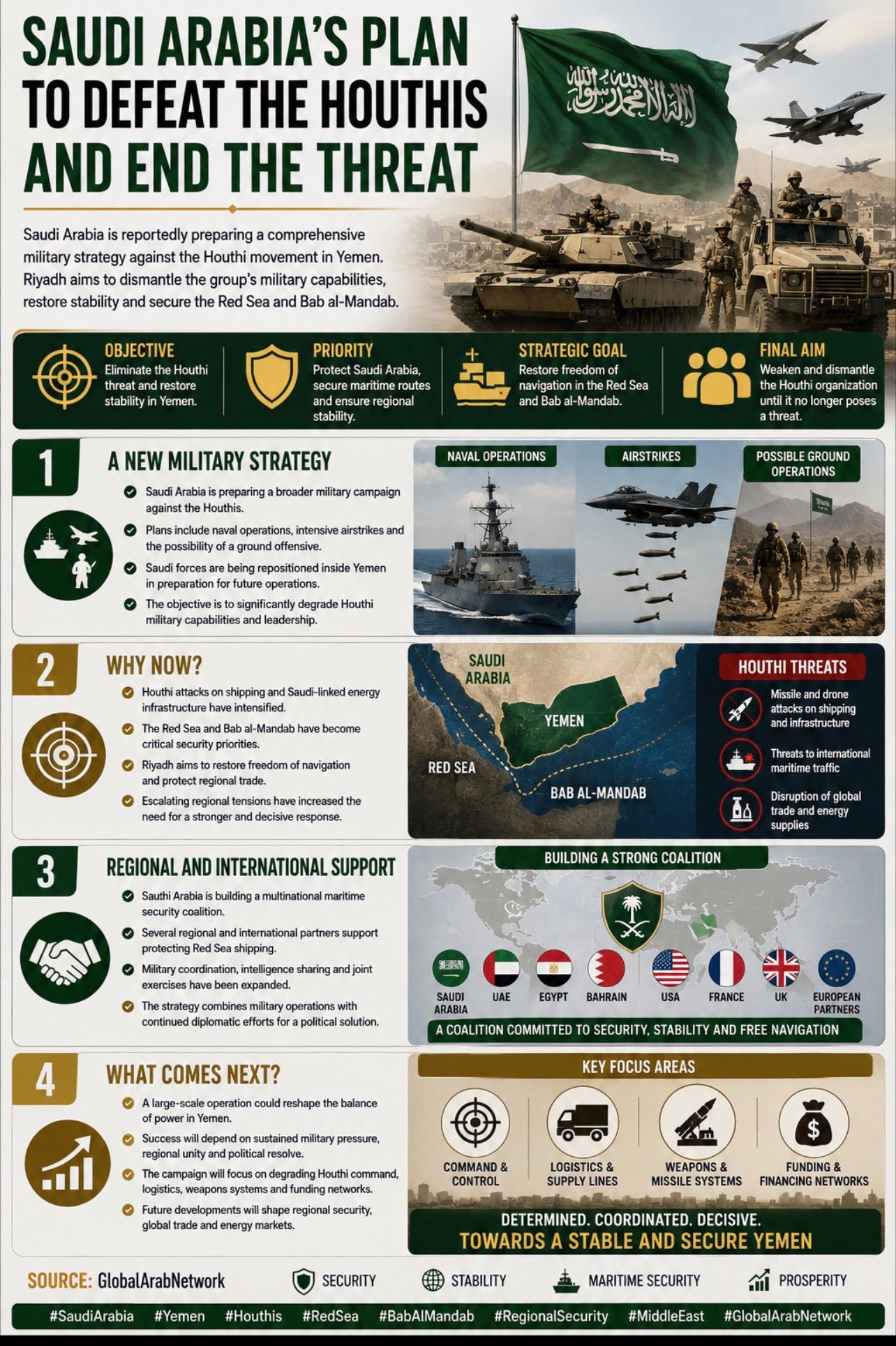
Saudi Arabia is reportedly preparing a new military strategy aimed at significantly weakening the Houthi movement in Yemen after months of escalating attacks on international shipping, regional security interests, and Saudi-linked economic infrastructure. According to multiple regional and international reports, Riyadh is studying a broader military approach that could combine naval, air, and potentially limited ground operations while strengthening cooperation with regional and international partners to restore security along one of the world’s most strategic maritime corridors.
The reported planning reflects growing concern over the Houthis’ expanding military capabilities and their continued ability to threaten commercial shipping in the Red Sea and Bab al-Mandab Strait—waterways through which a substantial share of global trade and energy supplies passes each year. While Saudi officials have not publicly announced a new campaign, military movements and diplomatic activity have fueled widespread speculation that preparations are underway for a more comprehensive strategy.
A New Military Strategy
Reports suggest Saudi military planners are evaluating a broader campaign designed to significantly degrade the Houthis’ operational capabilities rather than relying solely on defensive measures. The proposed strategy is believed to integrate air power, naval operations, intelligence assets, and support for Yemeni government forces on the ground.
Military analysts note that recent Saudi force repositioning in southern Yemen and along strategic areas has increased speculation that preparations may be underway for future operations. Although the exact scope remains unclear, discussions reportedly include the possibility of coordinated offensives targeting key Houthi military infrastructure, weapons depots, command-and-control centers, missile launch sites, and logistical networks.
Naval operations are expected to play a central role, particularly in securing shipping lanes through the Red Sea and Bab al-Mandab Strait. Enhanced maritime patrols, interception capabilities, and intelligence-sharing with allied navies could form an important component of the strategy.
Should ground operations be authorized, they are likely to involve Yemeni government forces supported by coalition assets rather than a large-scale Saudi ground deployment. Such an approach would seek to increase pressure on Houthi-controlled territory while minimizing broader regional escalation.
Why Now?
Several factors appear to be driving the renewed focus on military options.
Houthi attacks against commercial vessels in the Red Sea have continued to disrupt international shipping, forcing many shipping companies to reroute vessels around the Cape of Good Hope. These diversions have increased transportation costs, extended delivery times, and raised insurance premiums for global maritime trade.
Saudi officials also remain concerned about threats to critical energy infrastructure and strategic economic projects. Although attacks inside Saudi Arabia have declined compared with previous years, the continued development of Houthi missile and drone capabilities remains a significant security concern.
The Bab al-Mandab Strait has become one of the world’s most strategically important maritime chokepoints. Any prolonged disruption affects not only regional economies but also global supply chains and international energy markets. Restoring freedom of navigation has therefore become a priority shared by many governments.
Escalating regional tensions have further increased pressure for a stronger response. Policymakers increasingly argue that allowing continued attacks could embolden armed groups and undermine broader regional stability.
Building Regional and International Support
Saudi Arabia is also reportedly intensifying diplomatic efforts to strengthen a multinational security framework focused on protecting maritime trade routes.
Regional partners have emphasized the importance of ensuring freedom of navigation through the Red Sea, while several international governments have expanded naval deployments and maritime surveillance operations aimed at deterring attacks against commercial shipping.
Military coordination among allied nations has reportedly increased through intelligence-sharing, joint planning, and maritime security cooperation. The objective is to improve early warning capabilities, strengthen defensive measures, and enhance the protection of commercial vessels operating in high-risk waters.
At the same time, diplomatic engagement remains an important element of Saudi policy. Riyadh continues to support international efforts aimed at achieving a long-term political settlement in Yemen while seeking to balance military pressure with diplomatic initiatives intended to reduce regional tensions.
Analysts suggest that any future strategy will likely combine calibrated military action with continued political engagement, recognizing that a durable solution to Yemen’s conflict ultimately requires both security and diplomacy.
What Could Come Next?
If implemented, a large-scale campaign would represent one of the most significant shifts in Saudi policy toward Yemen in recent years.
Military objectives would likely focus on degrading Houthi command structures, disrupting logistics networks, limiting missile and drone capabilities, and reducing the group’s ability to threaten international shipping.
The effectiveness of such an operation would depend on several factors, including sustained military pressure, intelligence capabilities, coordination among coalition partners, and the ability of Yemeni government forces to capitalize on battlefield gains.
Observers caution that the conflict remains highly complex, and any military campaign would carry risks of further escalation and humanitarian consequences. Nevertheless, proponents argue that restoring security in the Red Sea has become an increasingly urgent strategic priority.
Strategic Implications
The outcome of any expanded Saudi military strategy could reshape the balance of power in Yemen and influence security dynamics across the wider Middle East.
A successful campaign that substantially weakens Houthi military capabilities could improve maritime security, reduce risks to international shipping, and reinforce confidence in one of the world’s most vital trade corridors. It could also contribute to greater stability for regional energy markets by reducing threats to critical infrastructure and commercial transport.
Conversely, prolonged military operations could generate new strategic challenges, highlighting the importance of maintaining close coordination between military, diplomatic, and humanitarian efforts.
As regional governments continue to monitor developments, the Red Sea and Bab al-Mandab are likely to remain central to international security discussions. Whether through military action, diplomacy, or a combination of both, efforts to secure these strategic waterways will have far-reaching consequences for regional stability, global trade, and international energy security in the months ahead.