U.S. Expands Sanctions on Global Networks Supporting Iran’s IRGC
By Global Arab Network
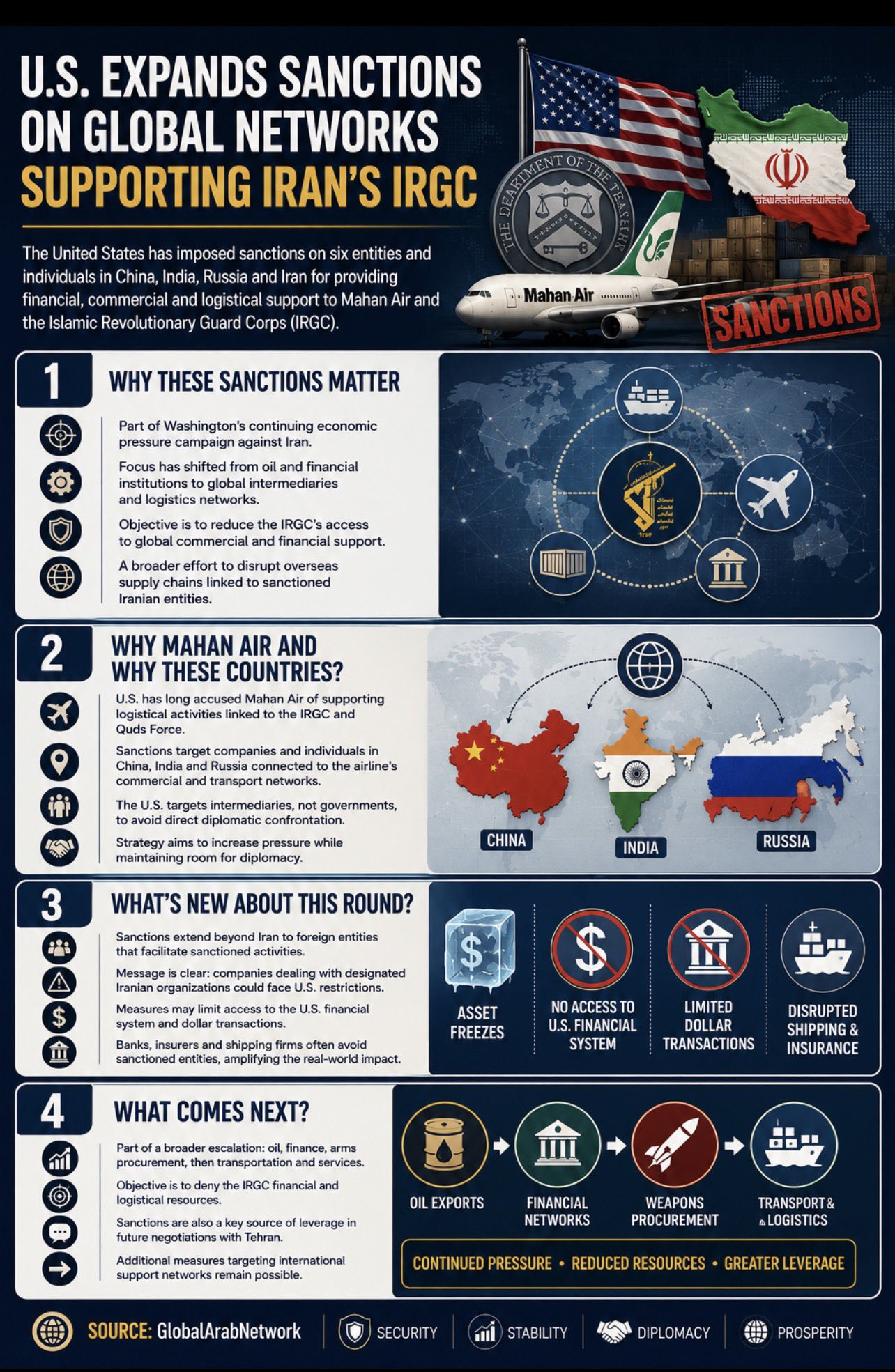
The United States has announced a new round of sanctions targeting six entities and individuals in China, India, Russia, and Iran, accusing them of providing financial, commercial, and logistical support to Mahan Air and the Islamic Revolutionary Guard Corps (IRGC). The measures represent the latest step in Washington’s “maximum pressure” strategy, which increasingly focuses not only on sanctioned Iranian organizations but also on the international commercial networks that enable them to conduct business.
According to the U.S. Treasury Department, the sanctions are intended to disrupt the overseas infrastructure that allegedly facilitates procurement, transportation, and financial transactions for Iranian entities already under U.S. restrictions. The latest designations underscore Washington’s growing emphasis on targeting intermediaries beyond Iran’s borders, reflecting an effort to increase economic pressure while limiting Tehran’s ability to circumvent existing sanctions.
Why These Sanctions Matter
The latest sanctions form part of the United States’ continuing campaign to restrict Iran’s economic and military capabilities through financial pressure rather than direct military confrontation.
For years, U.S. sanctions focused primarily on Iran’s oil exports, banking sector, and government institutions. However, policymakers have gradually expanded their approach to include the international companies, brokers, shipping firms, and financial intermediaries that allegedly facilitate transactions for sanctioned Iranian organizations.
U.S. officials argue that restricting access to these international commercial networks makes it significantly more difficult for the IRGC and affiliated organizations to obtain equipment, move goods across borders, or access foreign financial services.
The strategy reflects a broader shift toward disrupting global supply chains linked to sanctioned entities rather than targeting only organizations based inside Iran. By increasing the legal and financial risks for foreign companies, Washington hopes to reduce international business engagement with designated Iranian organizations.
Why Mahan Air and Why These Countries?
Mahan Air has long been a central focus of U.S. sanctions policy. Washington has repeatedly accused the Iranian airline of providing logistical support to the Islamic Revolutionary Guard Corps and its overseas operations, allegations that Iran has consistently rejected.
According to U.S. officials, the latest sanctions target companies and individuals operating within commercial and transportation networks connected to the airline. The designated entities are based in China, India, Russia, and Iran, reflecting what Washington describes as an international logistics network supporting sanctioned activities.
Importantly, the measures are directed at private businesses and individuals rather than the governments of those countries. This distinction allows the United States to increase economic pressure on commercial actors without directly escalating diplomatic tensions with major international partners.
Analysts note that this approach has become increasingly common in U.S. sanctions policy. Instead of broad country-wide restrictions, Washington has increasingly relied on targeted designations aimed at specific businesses, shipping companies, procurement agents, and financial facilitators believed to support sanctioned organizations.
What Is New About This Round?
While previous sanctions largely concentrated on Iranian institutions themselves, the newest measures extend further into the international commercial ecosystem that allegedly enables sanctioned organizations to operate.
The designations send a clear signal that foreign companies conducting business with sanctioned Iranian entities may themselves become subject to U.S. restrictions, even if they are headquartered outside Iran.
One of the most significant consequences of such sanctions is the potential loss of access to the U.S. financial system. Designated entities may be restricted from conducting transactions in U.S. dollars, accessing American financial institutions, or engaging with businesses that wish to avoid secondary sanctions.
Beyond the legal restrictions themselves, the practical impact often extends much further. International banks, insurers, shipping companies, freight operators, and logistics providers frequently avoid doing business with sanctioned entities altogether, significantly increasing commercial isolation for the targeted organizations.
This “de-risking” effect often amplifies the influence of sanctions beyond the formal legal framework, as many international companies choose to terminate business relationships rather than risk exposure to U.S. enforcement measures.
Washington’s Broader Strategy
The latest sanctions illustrate the continuing evolution of U.S. policy toward Iran.
Rather than relying exclusively on restrictions targeting oil exports or government ministries, Washington has expanded its focus to include procurement networks, shipping companies, aviation support services, financial intermediaries, and overseas commercial facilitators.
The objective is to limit the ability of sanctioned organizations to replace suppliers, move goods internationally, or establish alternative financial channels that could reduce the effectiveness of existing sanctions.
Officials argue that this network-focused strategy increases economic pressure while requiring fewer broad-based restrictions that could have wider humanitarian or diplomatic consequences.
The approach also reflects growing recognition that modern sanctions enforcement increasingly depends on monitoring international commercial relationships rather than simply restricting domestic Iranian institutions.
What Comes Next?
The latest designations are widely viewed as part of a broader pattern of escalating economic pressure that has gradually expanded from Iran’s energy sector into transportation, logistics, procurement, and international financial networks.
Washington maintains that its objective is to deny the Islamic Revolutionary Guard Corps access to the financial and logistical resources needed to sustain its regional activities. At the same time, U.S. officials continue to describe economic sanctions as an important source of leverage in any future diplomatic engagement with Tehran.
Analysts expect additional sanctions targeting overseas support networks if U.S. authorities determine that existing restrictions are being circumvented through new commercial channels. Companies operating in sectors such as shipping, aviation, freight forwarding, finance, insurance, and industrial procurement are therefore likely to remain under close scrutiny.
Future enforcement actions may also involve greater coordination with international partners, expanded intelligence sharing, and enhanced monitoring of cross-border commercial transactions involving sanctioned Iranian entities.
Strategic Implications
The expanding scope of U.S. sanctions demonstrates that Washington increasingly views international commercial networks as a critical component of Iran’s ability to sustain sanctioned organizations.
By targeting overseas intermediaries rather than only Iranian institutions, the United States aims to increase compliance costs for businesses worldwide and reduce opportunities for sanctions evasion.
Whether these measures significantly alter Iran’s operational capabilities remains a subject of debate among analysts. Supporters argue that sustained pressure can restrict access to critical resources and complicate procurement efforts, while critics contend that sanctioned networks often adapt by developing alternative financial channels and commercial partnerships.
Regardless of their long-term effectiveness, the latest sanctions reaffirm that economic pressure remains a central pillar of U.S. policy toward Iran. As geopolitical tensions continue across the Middle East, international businesses involved in trade, logistics, finance, and transportation are likely to face heightened scrutiny when dealing with entities linked to sanctioned Iranian organizations.