Libya’s Western Security Crisis Deepens as Fighting in Zawiya and Surman Raises Fears of Wider Instability
By Global Arab Network
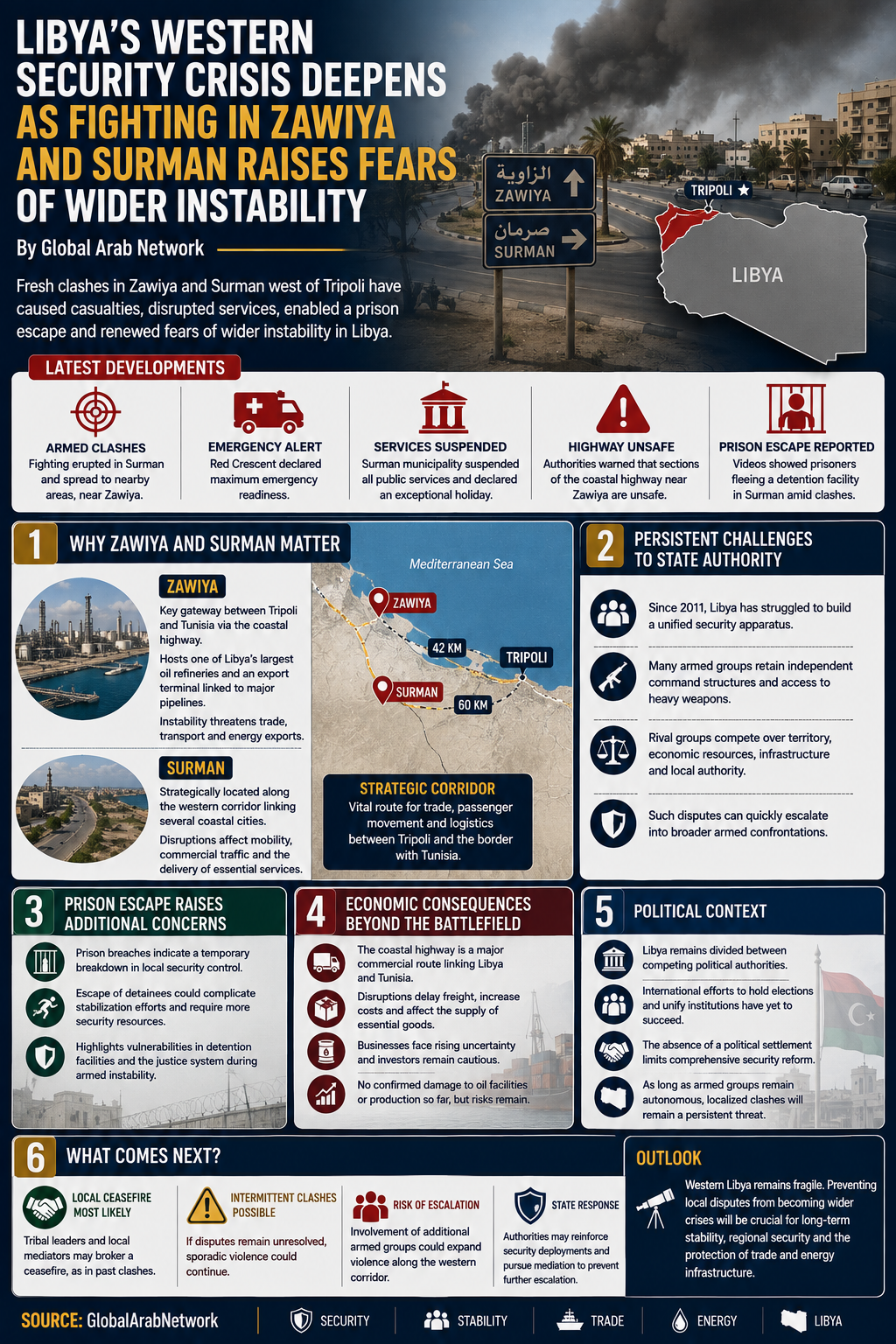
Fresh armed clashes in the western Libyan cities of Zawiya and Surman have highlighted the fragile security environment surrounding the capital, Tripoli, underscoring the continuing influence of rival armed groups despite years of political negotiations and repeated security reform efforts.
The violence, which erupted early Tuesday, resulted in casualties, forced local authorities to suspend public services, prompted emergency warnings from humanitarian organizations, and reportedly enabled prisoners to escape from a detention facility caught in the fighting. Although officials have yet to identify the groups involved or confirm casualty figures, the latest confrontation has renewed concerns that western Libya remains vulnerable to sudden outbreaks of violence capable of disrupting both national stability and regional economic activity.
A New Security Flashpoint in Western Libya
According to local reports, clashes began in areas surrounding Surman, approximately 60 kilometers west of Tripoli, before spreading toward neighboring districts. Libya’s Red Crescent declared a state of maximum emergency readiness, while municipal authorities urged residents to remain indoors and avoid conflict zones.
The municipality of Surman suspended operations across all public institutions, declaring an exceptional public holiday to protect employees and civilians.
Meanwhile, Libya’s Emergency and Ambulance Service warned motorists that sections of the strategic coastal highway near Zawiya, roughly 42 kilometers west of the capital, had become unsafe because of ongoing armed confrontations.
Videos circulating on social media appeared to show prisoners fleeing a detention facility in Surman amid heavy gunfire. Although authorities have not officially confirmed the scale of the prison escape, the incident has heightened concerns over the immediate security implications.
Why Zawiya and Surman Matter
The latest violence has occurred in one of Libya’s most strategically important regions.
Zawiya serves as the principal gateway between Tripoli and Tunisia via the Mediterranean coastal highway, making it a vital corridor for commercial trade, passenger movement, and logistical supply chains. Any prolonged disruption immediately affects transport between the capital and Libya’s western border.
The city also hosts one of Libya’s largest oil refineries and an important export terminal connected to inland oil fields through a network of pipelines. As a result, instability in Zawiya carries significance far beyond local security, with potential implications for energy production and export operations.
Surman, although smaller, occupies an equally important position along the western corridor linking several coastal cities. Security disruptions in the area can quickly affect mobility across western Libya and complicate the movement of emergency services, commercial traffic, and government agencies.
Persistent Challenges to State Authority
The latest clashes illustrate a structural problem that has continued to shape Libya’s security landscape since the collapse of the former regime in 2011.
Successive governments have struggled to establish a unified national security apparatus capable of exercising exclusive control over the use of force. While official security institutions have expanded in recent years, numerous armed groups continue to maintain independent command structures, local influence, and access to heavy weaponry.
In several western Libyan cities, these armed formations remain deeply embedded in local security arrangements, creating a complex environment in which disputes between rival groups can rapidly escalate into broader armed confrontations.
Although authorities have not publicly identified the parties involved in Tuesday’s fighting, analysts note that previous clashes in western Libya have frequently been driven by competition over territorial influence, economic resources, strategic infrastructure, and local administrative authority.
Prison Escape Raises Additional Security Concerns
Reports of prisoners escaping during the fighting represent one of the most serious developments arising from the latest violence.
Prison breaches during armed confrontations often indicate a temporary breakdown in local security control. If confirmed, the escape of detainees could complicate stabilization efforts by requiring additional security resources to locate and recapture those who fled.
The incident also highlights the vulnerability of detention facilities located near active conflict zones and raises broader questions regarding the resilience of Libya’s justice and prison systems during periods of armed instability.
Economic Consequences Beyond the Battlefield
The security implications extend well beyond the immediate conflict area.
The coastal highway linking Tripoli with western Libya and Tunisia is one of the country’s most important commercial routes. Interruptions along this corridor delay freight transport, increase logistics costs, and disrupt the movement of goods entering Libya from neighboring Tunisia.
Should instability persist, supply chains could experience further delays, potentially affecting the availability and pricing of consumer goods, construction materials, and industrial supplies in western Libya.
Businesses operating in the region also face increased uncertainty, reinforcing concerns among domestic and international investors about the country’s broader security environment.
The proximity of the clashes to major energy infrastructure has drawn additional attention, although there have been no confirmed reports of damage to oil facilities or interruptions to production.
Political Context
The renewed violence comes against the backdrop of Libya’s prolonged political stalemate.
Despite repeated international efforts to facilitate national elections and reunify state institutions, the country remains divided between competing political authorities and fragmented security structures. The absence of a comprehensive political settlement continues to limit the state’s ability to implement nationwide security reforms and fully integrate armed formations into unified institutions.
Analysts argue that as long as competing armed groups retain significant autonomy, localized disputes will continue to carry the risk of escalating into wider confrontations capable of threatening broader regional stability.
What Comes Next?
Several scenarios could emerge over the coming days.
The most likely outcome is the negotiation of a localized ceasefire through tribal leaders, municipal officials, or security intermediaries, a mechanism that has frequently succeeded in containing previous outbreaks of violence.
However, the possibility of intermittent clashes cannot be ruled out if underlying disputes remain unresolved. Continued instability could further disrupt commercial activity and increase pressure on security forces across western Libya.
A more concerning scenario would involve additional armed groups entering the conflict, potentially expanding violence along the western corridor and placing greater pressure on the security environment surrounding Tripoli.
Government authorities may also seek to reinforce security deployments in affected areas while pursuing mediation efforts aimed at preventing further escalation.
Outlook
The clashes in Zawiya and Surman serve as another reminder that western Libya’s security remains fragile despite periods of relative calm. While the immediate trigger for the fighting remains unclear, the events expose deeper structural challenges that continue to shape the country’s political and security landscape.
As Libya seeks to advance political reconciliation and institutional reform, the ability of state authorities to prevent localized armed disputes from evolving into broader security crises will remain a key measure of long-term stability.
For now, developments in western Libya are likely to be closely watched by regional governments, international partners, and energy markets alike, given the strategic importance of the area for trade, transportation, and national infrastructure.