Analysis: Trump Raises Pressure on Iran as Hormuz Talks Reach a Critical Juncture
By Global Arab Network
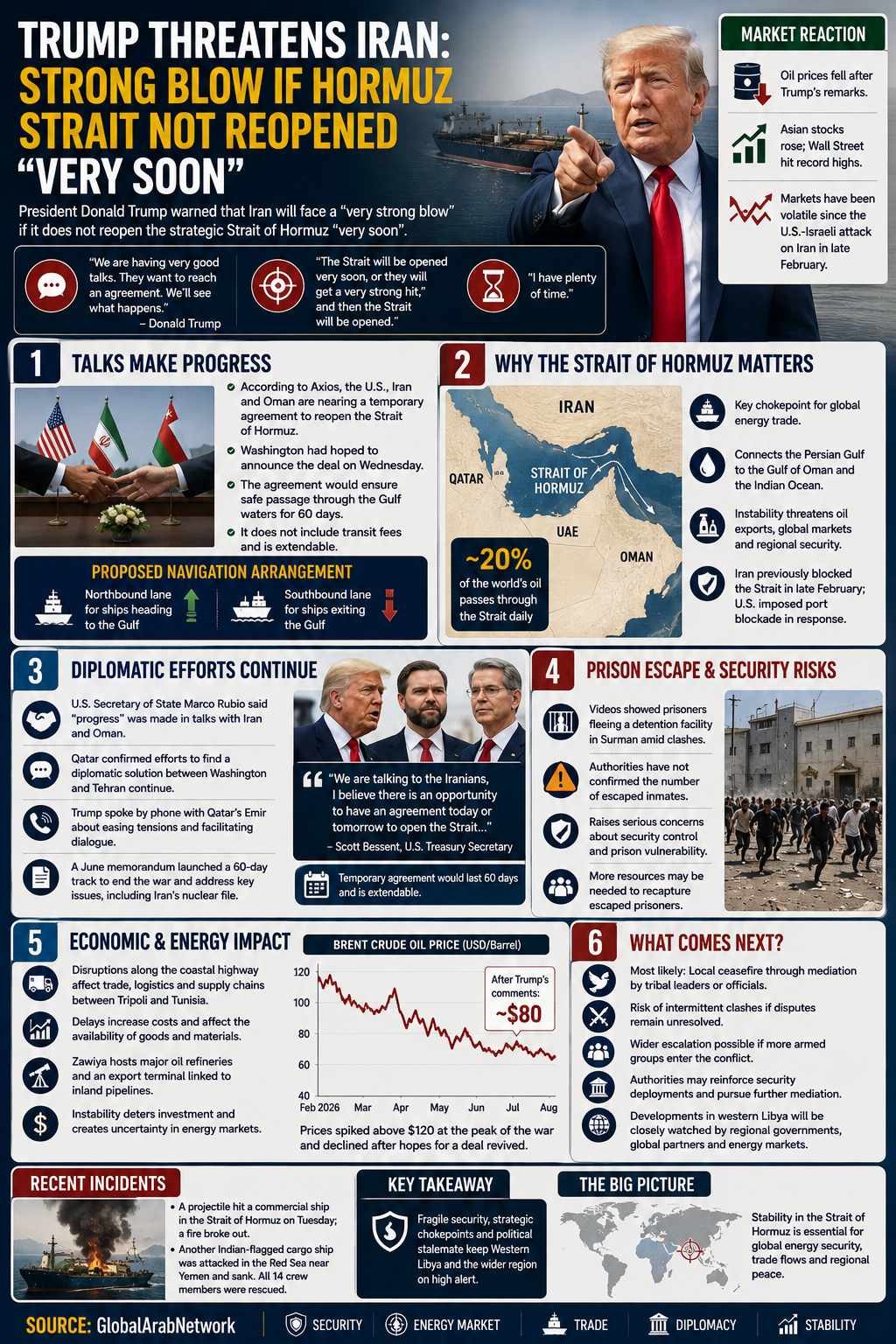
The crisis surrounding the Strait of Hormuz appears to be entering one of its most decisive phases since the outbreak of the U.S.-Iran conflict earlier this year. While diplomatic efforts involving Oman continue behind closed doors, President Donald Trump has dramatically raised the stakes, warning that Iran will face a “very powerful strike” if it fails to reopen the world’s most important energy shipping route “very soon.”
Trump’s remarks, delivered during a visit to California, came as multiple reports suggested that negotiations between Washington, Tehran, and Muscat were making progress toward a temporary arrangement that could restore commercial navigation through the strategic waterway.
The simultaneous combination of diplomatic optimism and explicit military threats reflects the dual-track strategy currently being pursued by the United States: maintaining overwhelming military pressure while leaving the door open for a negotiated solution.
Why the Strait of Hormuz Matters
Few waterways carry greater geopolitical significance than the Strait of Hormuz.
Located between Iran and Oman, the narrow passage connects the Persian Gulf with the Gulf of Oman and the Arabian Sea. It serves as the primary export route for oil and liquefied natural gas produced by Gulf states, making it one of the world’s most critical maritime chokepoints.
Any disruption immediately reverberates across global energy markets, insurance costs, shipping routes, and international supply chains.
Since Iran imposed restrictions on navigation following the escalation of hostilities with the United States, commercial shipping has faced growing risks. Tankers have been forced to delay voyages, reroute cargoes, or operate under heightened security measures, significantly increasing transportation costs.
The reopening of Hormuz has therefore become a priority not only for Washington and Tehran but also for Gulf producers, Asian energy importers, European economies, and global financial markets.
Trump’s Strategy: Maximum Pressure with an Open Door
President Trump’s latest comments illustrate the continuation of a negotiating approach that combines diplomatic engagement with credible military deterrence.
Speaking to Fox News, Trump declared that the Strait “will open very soon,” warning that failure to do so would result in a “very powerful strike.”
At the same time, he emphasized that discussions with Iran were progressing positively, suggesting Washington still believes diplomacy offers the fastest route to restoring maritime security.
This approach seeks to convince Tehran that reopening the Strait voluntarily is preferable to risking direct military confrontation.
By publicly stressing both negotiation and force, Washington is attempting to maximize leverage while reassuring international markets that it remains committed to restoring freedom of navigation.
The Emerging 60-Day Arrangement
According to officials cited by Axios, negotiators are discussing a temporary 60-day maritime arrangement rather than a comprehensive political settlement.
Under the reported proposal:
- Commercial shipping would resume through the Strait of Hormuz.
- Ships entering the Gulf would reportedly use designated northern navigation channels.
- Outbound vessels would sail through southern routes within Omani territorial waters.
- No transit fees would be imposed.
- The arrangement could be extended if negotiations continue successfully.
If finalized, such an agreement would represent a practical confidence-building measure designed to reduce immediate tensions without requiring either side to resolve broader disputes surrounding Iran’s nuclear programme or regional security policies.
The proposal illustrates a growing preference among mediators for incremental agreements that address urgent security concerns while leaving more politically sensitive issues for future negotiations.
Oman’s Quiet but Crucial Role
Throughout the crisis, Oman has once again emerged as one of the region’s most important diplomatic intermediaries.
Maintaining longstanding communication channels with both Washington and Tehran, Muscat has frequently played a behind-the-scenes role during periods of heightened regional tension.
Iranian officials have confirmed that discussions with Oman remain active, describing them as technical and political negotiations focused on establishing safe navigation routes that respect both Iranian sovereignty and Omani security interests.
Notably, Tehran continues to insist that it is not conducting direct negotiations with the United States, instead portraying the discussions as bilateral consultations with Oman over maritime arrangements.
This distinction allows Iranian leaders to pursue practical compromises while limiting domestic political criticism associated with direct engagement with Washington.
Contradictory Narratives Reflect Delicate Diplomacy
One of the most striking aspects of the current negotiations is the difference between American and Iranian public messaging.
Washington portrays the talks as part of broader diplomatic engagement capable of reducing tensions across multiple issues.
Iran, by contrast, insists discussions are limited exclusively to maritime navigation and denies any direct negotiations with the United States.
Such differences are common in high-stakes diplomacy, allowing each government to preserve domestic political narratives while quietly exploring areas of compromise.
Despite the contrasting rhetoric, statements from both sides indicate that discussions remain active and that neither party has entirely abandoned diplomatic options.
Markets Respond to Signs of Progress
Financial markets reacted immediately to indications that negotiations may be advancing.
Oil prices declined as traders reassessed the likelihood of prolonged disruption in the Strait of Hormuz. Brent crude, which had surged above $120 per barrel during the height of the conflict, retreated toward $80 following renewed optimism surrounding a potential maritime agreement.
Equity markets across Asia also strengthened, reflecting investor expectations that reopening the Strait could ease inflationary pressures, stabilize shipping costs, and reduce broader geopolitical uncertainty.
The market reaction highlights how closely global investors continue to monitor developments in the Gulf, where even limited disruptions can have worldwide economic consequences.
Security Risks Remain High
Despite diplomatic momentum, the security environment remains extremely fragile.
A commercial vessel caught fire Tuesday after reportedly being struck while attempting to transit the Strait, according to maritime security reports. Elsewhere, an Indian-flagged cargo ship sank near Yemen after coming under attack in the Red Sea, further demonstrating that maritime threats extend well beyond Hormuz itself.
India described attacks against commercial shipping as “deeply concerning,” reiterating calls for unrestricted freedom of navigation consistent with international law.
These incidents underscore that even if Hormuz reopens, broader regional maritime security challenges are unlikely to disappear overnight.
Regional Diplomacy Gains Momentum
Alongside Oman’s mediation, Qatar has continued diplomatic efforts aimed at reducing tensions between Washington and Tehran.
A telephone conversation between President Trump and Emir Sheikh Tamim bin Hamad Al Thani focused on ongoing initiatives to narrow differences and support regional de-escalation.
Meanwhile, Secretary of State Marco Rubio confirmed that “progress” had been achieved in discussions while cautioning that no final agreement had yet been reached.
The growing involvement of Gulf states reflects increasing regional concern over the economic consequences of prolonged instability in one of the world’s most strategically important maritime corridors.
What Comes Next?
Several scenarios remain possible.
Scenario One: Temporary Maritime Agreement
Negotiators finalize the reported 60-day arrangement, allowing commercial shipping to resume while broader political negotiations continue.
Probability: High
Scenario Two: Limited Delays
Technical disagreements postpone implementation, but negotiations remain active without major military escalation.
Probability: Moderate
Scenario Three: Diplomatic Collapse
Talks fail, prompting renewed restrictions on shipping and increasing the likelihood of military confrontation following Trump’s warning.
Probability: Moderate
Scenario Four: Broader Political Breakthrough
Successful maritime negotiations evolve into wider discussions covering sanctions, regional security, and elements of the Iranian nuclear issue.
Although currently less likely, this outcome would represent the most significant diplomatic breakthrough in years.
Probability: Low to Moderate
Strategic Outlook
The negotiations over the Strait of Hormuz have become far more than a discussion about maritime navigation. They now represent an important test of whether limited, practical agreements can reduce tensions between two longstanding adversaries without immediately resolving their deeper political disputes.
For Washington, reopening the Strait would demonstrate the effectiveness of combining military pressure with diplomacy.
For Tehran, securing a maritime arrangement without making broader political concessions would help ease economic pressure while preserving strategic leverage.
For Gulf states and the wider international community, success would restore confidence in one of the world’s most vital energy corridors and reduce the immediate risk of further disruption to global trade.
Whether diplomacy ultimately prevails or military pressure intensifies will likely determine not only the future of the Strait of Hormuz but also the broader trajectory of regional security in the months ahead.
